Thursday, August 5, 2010

PEER Critical of EPA on Environmental Justice Guidance


The Press Release below is from the Public Employees for Environmental Responsibility


EPA RETREATS FROM ENVIRONMENTAL JUSTICE

Convoluted Guidance Paralyzes Decisions as Priority Pollution Efforts Ebb

Washington, DC - Rather than directly confront environmental justice challenges, the Environmental Protection Agency has issued internal guidance that is so convoluted and vague that it will stymie effective action, according to Public Employees for Environmental Responsibility (PEER). At the same time, EPA is allowing affirmative approaches to relieving the air pollution burden on the urban poor to languish.

In late July, EPA released its "Interim Guidance on Considering Environmental Justice During the Development of An Action" which proclaims that it "empowers decision-makers" to "integrate EJ [environmental justice] into the fabric of EPA's" actions. The actual guidance, however, lays out a stultifying multi-step process steeped in terms that seem designed to encourage inaction. For example, a flow-chart maps out 29 possible steps for "incorporating environmental justice" including sphinx-like admonitions such as -

"Identify whether EJ concerns have been addressed. Be prepared to answer 3 core questions." and

"If applicable, address outreach, consider highlighting EJ options for comment, and address significant EJ issues in Action Memo."

"This new guidance imprisons environmental justice inside a bureaucratic Rubik's Cube that will confound even the most ardent EPA employee," stated PEER Executive Director Jeff Ruch, noting Administrator Lisa Jackson has declared environmental justice one of her priority issues.

"This continues the pattern at EPA on environmental justice of putting process over substance."

By contrast, this June the EPA Office of Inspector General slammed EPA for a decade-long failure to implement national urban air toxics control plans, designed to alleviate a major public health threat to the nation's urban centers with concentrations of disadvantaged populations. The Clean Air Act Amendments of 1990 required EPA to develop a strategy to reduce air toxics emissions in urban areas, particularly from small stationary sources. While the agency was required to issue new urban emissions standards in 2000 for these smaller local sources, such as cars, dry cleaners and gas stations, EPA failed to follow through. Yet EPA figures show acute risks from these local sources - potentially causing cancer in one in 28,000 Americans with two million residents in areas where the lifetime risk was one in 10,000 or greater.

"Why can't EPA make direct action to reduce the pollution load on urban poor a priority?" asked Ruch, decrying the lack of concrete results from EPA environmental justice efforts. "What good is a rhetorical commitment to environmental justice if our poorest citizens remain disproportionately exposed to toxins by virtue of where they live?"

Follow (if you can) the 29 simple steps for "Incorporating Environmental Justice" at EPA

Read the draft EPA Environmental Justice Guidance

Look at the 2010 Inspector General report on urban air toxics

See how bureaucracy trumps environmental justice at EPA

Contact: Kate Hornyan (202) 265-7337

Thursday, July 29, 2010

National Institutes of Health Small Research Grants


The National Institutes of Health (NIH) has released a new funding opportunity to support small research projects examining the differential risk factors of populations that lead to or are associated with increased vulnerability to exposures, diseases and other adverse health outcomes related to climate change. Applications may involve either applied research studies that address specific hypotheses about risk factors or population characteristics associated with increased vulnerability, or research projects to develop general models or methods for identifying and characterizing population vulnerability to climate change. The ultimate goal of this research program is to help informclimate change adaptation and public health interventions to reducecurrent and future vulnerability of various populations to the health effects of climate change.

A complete copy of the PAR (PAR-10-235) is available online. This program has been released for a three-year period with three application receipt dates. The first application receipt date is September 28, 2010. Prospective applicants are asked to submit a letter of intent (LOI) by August 28, 2010. The earliest anticipated start date is July 1, 2011. Please contact Caroline H. Dilworth at 919-541-7727 at NIEHS if you have questions.

Tuesday, July 27, 2010

Plan EJ 2014 Released - Comments Requested


Plan EJ 2014, named in recognition of the 20th anniversary of the issuance of Executive Order 12898, Federal Actions to Address Environmental Justice in Minority Populations and Low-Income Populations PDF (6 pp, 122K), is EPA’s overarching strategy for carrying out the Administrator’s priority.

Over the next four years, EPA will implement and seek to strengthen efforts under the five Cross-Agency Focus Areas outlined in the plan:

Rulemaking;
Permitting;
Compliance;
Community-Based Action; and
Administration-Wide Action on Environmental Justice.

Visit Plan EJ 2014 and submit your comment today. Comments are due October 1, 2010.

Monday, July 26, 2010

EPA Releases Environmental Justice Guidance Rulemaking


The U.S. Environmental Protection Agency (EPA) is releasing an interim guidance document to help agency staff incorporate environmental justice into the agency’s rulemaking process. The document, Interim Guidance on Considering Environmental Justice During the Development of an Action, seeks to advance environmental justice for low-income, minority and indigenous communities and tribal governments who have been historically underrepresented in the regulatory decision-making process. The guidance also outlines the multiple steps that every EPA program office can take to incorporate the needs of overburdened neighborhoods into the agency’s decision-making, scientific analysis, and rule development. EPA is seeking public feedback on how to best implement and improve the guide for agency staff to further advance efforts toward environmental justice.

To view the interim guidance and submit feedback

More information on environmental justice

Friday, July 2, 2010

EJ Summit & Call For Research Presentations


Call For Research Presentations on Environmental Justice

Environmental Justice Summit

October 15-16, 2010

Sponsored by the North Carolina Environmental Justice Network (NC EJ Network)

North Carolina's 12th Annual Community-Based Environmental Justice Summit will be held October 15-16, 2010 at the Historic Franklinton Center at Bricks, Edgecombe County, NC. Community members, government officials, environmentalists, students and researchers will participate. The Summit seeks to raise public awareness about environmental justice; connect communities in need with technical resources; support and encourage community-driven research; help communities and policy makers address problems of environmental injustice; and bring about positive changes in public health and the environment by promoting social and environmental justice.

This announcement is a call for research presentations on environmental justice. The NC EJ Network invites submissions that address environmental justice topics from any disciplinary perspective, including environmental sciences, social sciences, humanities, law, journalism, public health and medicine. Although most Summit participants are from NC, they welcome any submissions that have relevance to environmental injustices in NC. Researchers who have conducted community-driven or community-based research are encouraged to present in collaboration with members of community groups. Research presentations (approximately 15 minutes in length) will be given at a plenary session on Friday afternoon, October 15.

Please submit a title, author(s) and abstract (250 words or less) of your research by Friday, September 3, 2010 to:

Steve Wing Department of Epidemiology, CB#7435 University of North Carolina, Chapel Hill, NC 27599-7435 919-966-7416 steve_wing@unc.edu

Abstracts may be submitted by mail or e-mail. Submissions must include the following information: name, organization, street address, city, state, zip, phone, e-mail, audio/visual needs, title, authors, affiliations, and your abstract (250 words or less). Additionally, e-mail submissions should have a subject line indicating “EJ Summit Abstract.”

Abstracts will be reviewed by the Environmental Justice Summit Coordinating Committee. Notification of acceptance for presentation will be sent by September 15, 2010. Authors will be expected to submit a final version of the abstract following the Summit for inclusion in conference proceedings.

As a coalition of community-based organizations, the NC EJ Network is not able to provide travel funds to academics, researchers, and government officials. Community scholarships will be available by application.

Tuesday, June 29, 2010

Strengthening Environmental Justice Research and Decision Making


UPDATE: Strengthening Environmental Justice Research and Decision Making: A Symposium on the Science of Disproportionate Environmental Health Impacts

UPDATE: 100 days after the conclusion of the Strengthening Environmental Justice Research and Decision Making: A Symposium on the Science of Disproportionate Environmental Health Impacts, EPA has prepared an update that includes:

1) an overview of the Symposium participant recommendations;

2) EPA’s plan to work with the recommendations;

3) upcoming opportunities to provide additional comments and recommendations, and;

4) a reaffirmation of EPA’s commitment to work with community groups and the public to strengthen local environmental and human health outcomes.

EPA is accepting additional recommendations and feedback via their website and will host a teleconference on July 29th from 2-3pm Eastern. Information on how to participate on the teleconference call will be provided in the coming weeks.

For more information or to post a comment

For more information about the symposium

Wednesday, June 23, 2010

Brainstorming Session for Smart Growth Conference


The EPA and the Local Government Commission (LGC) are co-leading a brainstorming meeting with equity and environmental justice leaders from across the country for the purpose of brainstorming equity and environmental justice session topics for possible inclusion in the New Partners for Smart Growth 2011 conference program. The goal is to engage equity and EJ groups and hear directly from them what session topics would be relevant and inform their ongoing work in communities across the country.

While they are encouraging all to formally submit sessions proposals by the deadline of June 30th, they believe this conference call will provide the opportunity to identify a strong list of key issues to consider, and ideally a list of possible case studies/speakers that could be considered for inclusion in other session proposals received under several thematic categories. Putting together such a list will help them in their efforts to ensure that other sessions on the program outside the Equitable Development track include equity and EJ perspectives by including relevant case studies, speakers and respondents where appropriate.

The call will be held on Tuesday, June 29 at 3:00 EST. They realize this is short notice, but they are hopeful you can fit this conference call into your schedule. Please let them know right away if you can participate, and no later than June 25th. They will be sending out an agenda with call-in details on Monday, June 28th.

Please contact Michele Warren with questions.

Saturday, June 19, 2010

Environmental Justice & the Gulf of Mexico Oil Spill


More than 370 callers participated on a call sponsored by the National Environmental Justice Advisory Council (NEJAC) on Tuesday. Callers recommended that federal agencies should do a better job of ensuring that both the people working to clean up the oil in the Gulf of Mexico and on shore and residents of coastal communities are protected from the spill's health effects. The council advises EPA on environmental justice issues. EPA Administrator Lisa Jackson participated on the call stating that, "The people who are most vulnerable to the impacts of this spill must be empowered during our response and the long-term recovery."

Both council members and members of the public who called in comments during the meeting, expressed concern about plans to dispose of oil wastes and thousands of miles of oiled boom in ordinary landfills after an EPA official told the commission that the agency had concluded the materials did not meet the legal definition of hazardous waste. Local communities in the area believe the oiled booms should be treated as a toxic material and be discarded in a safe way.

One participant maintained that BP had contracted with waste disposal giant Waste Management Inc. to use its landfills in Louisiana and other coastal states, but that the Waste Management landfill in Louisiana was not on a list of approved landfills in Louisiana's oil spill response plan.

Call participants expressed how oil spill workers also are fearful they will lose their jobs if they report illnesses they believe are linked to the fumes given off by the oil. Callers recommended that federal and state officials also need to do a better job publicizing fishing closures to fishers who don't speak English. (NOLA.com, 6/15/2010)

Friday, June 18, 2010

NEJAC Registration for July 27-29 Public Meeting


National Environmental Justice Advisory Council (NEJAC) Registration for the July 27-29, 2010 Public Meeting NOW OPEN‏

The next NEJAC face-to-face meeting will take place in Washington, D.C., on July 27 through 29, 2010, at The Fairfax at Embassy Row. The meeting will include a Public Comment period.

Meeting Registration: Registration is required for everyone (including EPA and other federal employees). The registration deadline is 10 a.m. Eastern Time on Friday, July 16, 2010. Meeting materials will be prepared based on the number of participants registered on July 16. (On-site registration will be available; however, meeting materials will be distributed first to those who registered in advance. Any remaining materials will be distributed on a first-come first-serve basis.)

There are four easy ways to register:

Online: Complete the online registration form at the NEJAC meetings page on EPA's Office of Environmental Justice Web Site.
By E-mail: Send an e-mail to with “Register for the July NEJAC Meeting” in the subject line. Please provide your name, organization, e-mail and telephone number for future follow-up as necessary.
By Fax: Print the Web page containing the registration form and fax to 877-773-0779.
By Phone: Leave a message at 877-773-0779. Please provide your name, organization, e-mail and telephone number for future follow-up as necessary.

Public Comment Period: Members of the public who wish to speak during the Public Comment period should pre-register by 10 a.m. Eastern Time on Friday, July 16, 2010. Comments will be limited to five minutes to ensure that as many participants as possible wishing to provide a comment may do so. Only one representative of a community, organization or group will be allowed to speak.

Written comments can also be submitted for the record. The suggested format for individuals providing public comments is as follows: Name of Speaker, Name of Organization/Community, Address/Telephone/E-mail, Description of Concern and its Relationship to a Specific Policy Issue(s), and Recommendations or desired outcome. Written comments received by 10 a.m. Eastern Time on Friday, July 16, 2010, will be included in the materials distributed to the members of the NEJAC. Written comments received after that time will be provided to the NEJAC as logistics allow. All written comments.
For more information, please contact EPA Support Contractor, APEX Direct Inc., at 877-773-0779 or.

Friday, June 11, 2010

New Lawyers' Committee Environmental Justice Report


"Now is the Time: Environmental Injustice in the U.S. and Recommendations for Eliminating Disparities"

The Lawyers' Committee for Civil Rights Under Law, in collaboration with numerous environmental justice advocates, has released its report, "Now is the Time: Environmental Injustice in the U.S. and Recommendations for Eliminating Disparities." The purpose of the report is to outline recommendations on how the Administration can effectively utilize existing law to eliminate disparities in environmental protection and the agencies can fulfill their responsibilities under Executive Order 12898, "Federal Actions To Address Environmental Justice In Minority Populations And Low-Income Populations."

Key recommendations include:

The Environmental Protection Agency (EPA) should emphatically and resolutely embrace a strong definition of environmental justice grounded in the central tenet that environmental justice is the prevention, reduction and elimination of the known disproportionate environmental burdens primarily on people of color, indigenous, and low-income communities.

EPA should make full use of existing legal authority to address environmen­tal assaults on people of color, indigenous, and low-income communities.

DOJ should develop guidelines for Title VI compliance in the context of emer­gency preparedness and emergency response for recipients of federal funding.

Reinstatement of the superfund tax on chemical and petrochemical manufacturers through congressional reauthorization of the Superfund tax.

The Administration should ensure that any carbon trading market is properly regulated to address and redress co-pollutant issues that are known to co-exist with the establishment of carbon markets and should prepare climate change disaster mitigation programs specifically for residents of urban, indigenous, low-income and environmental justice communities.

EPA should set federal guidelines for state and local schools agencies on indoor air quality in schools, integrated pest management, school chemical cleanouts, drinking water, school design, asbestos, PCBs in caulking, molds, comprehensive building inspections, and how pediatric environmental health specialty units (PEHSUs) can work with state health agencies on on-site investigations.

The Department of Education should endorse the EPA Model School Siting Guidelines and require all recipients of federal assistance to comply with it.

Eighty percent of the funding from the Surface Transportation Authorization Act should be committed to public transit, 20 percent to highway and road maintenance rather than new road construction. Under the Surface Transportation Authorization Act of 2009/10, a minimum of 50 percent of the entire Act's allocation for transit should be dedicated to operating purposes, with at least half of that restricted to bus operations.

Strengthen regulation of emissions from concentrated animal feeding opera­tions, such as ammonia, hydrogen sulfide, and volatile organic compounds emissions. The Administration should ensure that rural areas are provided with ad­equate water and sewer services by working with local agencies and ensuring vigorous enforcement of the Safe Drinking Water Act in rural and semi-urban communities.
Lawyers' Committee for Civil Rights Under Law
1401 New York Avenue, NW, Suite 400
Washington, D.C. 20005
202-662-8600
Fax: 202-783-0857

Thursday, June 10, 2010

EPA NEJAC Conference Call on Gulf Oil Spill


Conference Call on EPA's Activities Related to Gulf of Mexico Oil Spill‏

Stakeholders and Interested Parties are invited to participate on a conference call hosted by EPA’s National Environmental Justice Advisory Council (NEJAC), scheduled for Tuesday, June 15, 2010 from 1:00 - 4:30 p.m.

The primary purpose of this call is to discuss EPA’s activities related to the Gulf of Mexico oil spill, including cleanup and recovery actions, and the impacts of the spill on coastal environmental justice communities. There will be a public comment period from 2:30 p.m. to 4:00 p.m. EDT. Specifically, the NEJAC is seeking input about:

(1) how should EPA engage communities around the environmental cleanup and recovery actions;

(2) how should EPA engage other federal, state, tribal, and local governments to ensure that coastal planning and protection efforts are a high priority; and

(3) the scope of disaster preparedness efforts within communities.

Pre-registration is required to participate on the call. Registration closes Friday, June 11th at noon, EDT. A finite number of telephone lines will be reserved for the call. Full capacity is anticipated, so please register by:

(1) E-mail with “Register for the June NEJAC Teleconference” in the subject line. Please provide your name, organization, address, e-mail and telephone number for future follow-up as necessary.

(2) Phone or Fax: Send a fax (please print), or leave a voice message, with your name, organization, address, e-mail and telephone number to 877-773-1489.

(3) To register online

If you have further questions, please feel free to email or call: Doretta Reaves at or 202.564.7829.

Thursday, May 27, 2010

NEJAC Public Teleconference Meeting June 15, 2010

Registration Now Open‏

The National Environmental Justice Advisory Council (NEJAC) will host a Public Teleconference Meeting June 15, 2010 from 1:00 to 4:00 pm (Eastern) to discuss EPA’s response to the BP Oil Spill in the Gulf of Mexico.

In light of the recent oil spill in the Gulf Coast, and NEJAC’s continued interest in the effects of such disasters on surrounding communities, NEJAC will host a public teleconference call on Tuesday, June 15, 2010. The primary purpose of the call is to discuss EPA’s activities related to the Gulf of Mexico oil spill, including cleanup and recovery actions, and the impacts of the spill on coastal environmental justice communities. There will be a public comment period from 2:30 p.m. to 4:00 p.m. Eastern Time. Members of the public are invited to provide comments relevant to the topic of this teleconference meeting. Specifically, the NEJAC is seeking input about:

(1) The scope of disaster preparedness efforts within communities.
(2) How should EPA engage other federal, state, tribal, and local governments to ensure that coastal planning and protection efforts are a high priority.
(3) How should EPA engage communities around the environmental cleanup and recovery actions.

A finite number of telephone lines will be reserved for the call. Registration is required. Full capacity is anticipated, so you are highly encouraged to register early.

Meeting Registration: Registration is required for everyone (including EPA and other federal employees). The registration deadline is Noon (12:00 p.m.) Eastern Time on Friday, June 11, 2010.

There are two easy ways to register:

By E-mail: Send an e-mail with “Register for the June NEJAC Teleconference” in the subject line. Please provide your name, organization, e-mail and telephone number for future follow-up as necessary.

By Phone or Fax: Send a fax (please print), or leave a message, with your name, organization, address, e-mail and telephone number to 877-773-1489.

Public Comment Period

In addition to presentations and discussions by community representatives, EPA senior management, and NEJAC members, there will be a public comment period.
Approximately 1.5 hours of the 3-hour call will be devoted to the public comment period.
You must pre-register to provide comments.

All comments will be limited to five minutes to ensure that as many participants as possible wishing to provide a comment may do so. Only one representative of a community, organization or group will be allowed to speak.

Written comments can also be submitted for the record.

The suggested format for individuals providing public comments is as follows: Name of Speaker, Name of Organization/Community, Address/Telephone/E-mail, Description of Concern, and Recommendations or desired outcome.

Written comments received by Noon (12:00 p.m.) Eastern Time on Friday, June 11, 2010, will be included in the materials distributed to the members of the NEJAC. Written comments received after that time will be provided to the NEJAC as logistics allow. All written comments should be sent to NEJAC.

For more information, please contact EPA Support Contractor, APEX Direct Inc., at 877-773-1489.

Tuesday, May 18, 2010

EPA Environmental Justice Awards Program Application


EPA is looking for 2010 applications!

EPA’s National Achievements in Environmental Justice Awards Program recognizes community-initiated, multistakeholder partnerships that result in Environmental Justice Achievements in communities.

The goal of the Awards Program is to encourage achievement of public and environmental health results in communities, to foster collaborative problem-solving by all stakeholder organizations to address significant Environmental Justice concerns, and to document successful activities that can be used in other communities.

Applications must be postmarked by August 13, 2010.

More information

Friday, May 14, 2010

Exhibits: Environmental Justice in America 2010


Exhibitors:

• U.S. Department of Energy
• U.S. Environmental Protection Agency
• U.S. Department of Interior
• U.S. Department of Agriculture
Office of Forest Service
Office of Rural Development
• Heat Smart Campaign
• RPM Ecosystems

Day 3: Plenary Sessions & Congressional Luncheon


Plenary - USDA Equitable Environmentalism
Edmund Gee, U.S. Forest Service
Beattra Solomon Wilson, U.S. Forest Service
Session Manager: Pat Jackman, U.S. Forest Service

Plenary- Environmental Justice at DOE Sites
Stephanie Owens, U.S. Environmental Protection Agency
Gerald Boyd, Manager, Oak Ridge Site Office
Vincent Adams, Manager, Portsmouth Site Office

Plenary - Environmental Health Issues in Indian Country
Derrick Watchman, Watchman & Associates
Jerry Pardilla, National Tribal Environmental Council
Stacy A. Bohlen, National Indian Health Board
Perry H. Charley, Dine’ College
Session Manager: Karyn Collins, U.S. Department of Energy

Congressional Closing Luncheon A Discussion on Health, Energy and Jobs
Dr. David Rivers, Medical University of South Carolina
Presiding: The Honorable Donna M. Christensen, U.S. House of Representatives, D-Virgin Islands
Panel:
The Honorable Donald Payne,
U.S. House of Representatives, D- New Jersey, 10th District
The Honorable Judy Chu (invited),
U.S. House of Representatives, D- California, 32nd District
The Honorable G.K. Butterfield (invited),
U.S. House of Representatives, D- North Carolina, 1st District
The Honorable Emanuel Cleaver (invited),
U.S. House of Representatives, D- Missouri, 5th District
The Honorable Charles Gonzalez (invited),
U.S. House of Representatives, D- Texas, 20th District
Closing Remarks

Day 2: Concurrent Sessions: EJ in America 2010


Washington Marriot Hotel at Metro Center
Washington, DC

The Price of Environmental Racism in a Community:
The History and Potential Future of Hyde Park, Augusta, GA

Curtis Fease, Augusta State University
Julie Hudson, Augusta State University
Ashlyn Meyers, Augusta State University
Heather Valentine-Gates, The Urban Environment Institute of Georgia
Plastic Bottles and Environmental Justice:
Michael Biggs, Tennessee State University

EDUCATE, EMPOWER, EMPLOY
SRS Superfund Job Training Initiative
Brendolyn Jenkins, The Imani Group, Inc.
Session Manger: Denise Mercer, SM Stoller Corporation

Working for Food Justice: Geospatial technology Applications in Delineating Urban Food Deserts and Associated Racial Health Disparities
Nekya Young, Tennessee State University
Ethnicity, Income and Exposure to Heavy Metals by Urban Gardeners
Jennifer Gorospe, San José State University
Urban Inner City- Treks-n-Trails
Kwame Lillard, African American Cultural Alliance
Session Manager: Pamela Pontillo, U.S. Department of Energy

Transforming and Diversifying HBCUs through Collaborative Relationships
Senora Coggs, U.S. Department of Commerce
Ty Couey, Mid-Atlantic HBCU Alumni Association Collaboration
Karen Wilson, Tougaloo College
Sandra Lawson, Univ of District of Columbia
Session Managers: Sheryl Good, U.S. Environmental Protection
Nick Ogden, Jr., U.S. Department of Commerce

Brownfields and Environmental Justice: New Initiatives for a New
Decade of Community Revitalization

Joe Bruss, U.S. Environmental Protection Agency
Deeohn Ferris, Sustainable Communities Development Group, Inc.
Aimee Storm, U.S. Environmental Protection Agency
Session Manager: Shirley Wade, SM Stoller Corporation

Hawaii: A Case for Re-Characterizing the "Environment" in Environmental Justice
Laura Baker, U.S. Environmental Protection Agency
Workshop: Evaluating Environmental Justice Strategies in Federal Agencies: A Regional Focus
Ryan Jackson, Columbia University

Norris McDonald, Ben Wilson, Robert Stanton, John Rosenthall

The Time is Now: Implementation of Environmental Justice Policy in the Obama Administration
Daria Neal, Lawyers Committee for Civil Rights

Dialogic Transformations in US Land Revitalization Policy and Planning
Courtney Knapp, Northern Middlesex Council of Governments
Session Manger: Rhonda Brown, U.S. Department of Agriculture

Putting the Neighbor Back in the ‘Hood
LaTrenia Byrd, University of Arkansas
Ratnasari Dewi, University of Arkansas
Nathaniel Owen, University of Arkansas

Chemicals in Your Community: What You Need to Know
Deborah Brown, U.S. Environmental Protection Agency
Session Manager: Fred Jenkins, U.S. Environmental Protection Agency

Ignacia Moreno, Eric Holder

Lunch Keynote
Ignacia Moreno, Assistant Attorney General, Environment and Natural Resources Division, U.S. Department of Justice

Introduction and Presiding Officer: Cheryl Cook, Deputy Under Secretary, U.S. Department of Agriculture

Agnes L. Savoy
DOE Environmental Research
Rukia Dahir, George Washington University
Jennifer Lynette, George Washington University
Elizabeth Krone, George Washington University
Macrina Xavier, George Washington University
Jason Fraley, George Washington University


Lilia Abron, James Hill

Elemental Composition of Influent, Treated Sludge and Effluent Water
Randy Arnold, Savannah State University
Session Manager: Holly Cairns, Department of Environmental Protection, State of Pennsylvania

Plenary - Historically Black Colleges and University/Minority Serving Institutions
Calvina Allen Dupre, U.S. Agency for International Development
Senora Coggs, U.S. Department of Commerce

David Padgett, Kimberly Jackson
Workshop: Geographic Information Systems Applicants in Environmental Justice David Padgett, Tennessee State University
Christopher Norwood, Tennessee State University
Honoring Navajo Code Talker Brother Jack Jones Practical Retrofit of Sustainable Building Technologies to Native American Church Facilities and Entry Level Housing for Citizens and Discussion on Micro-Growing Programs.
Michael Loya, La Mesilla Verde
Session Manager: Beverly Whitehead, U.S. Department of Energy

Patricia Jackman, John Rosenthall

African American Stakeholder’s Environmental Perception with Regard to a Major Urban Development Project
Hermaine Pierre, Tennessee State University
Organizing Across Boarders: Building a Global for Environmental and Climate Justice
Nina Birger, Tufts University
Emily Pistell, Tufts University
RPM Urban Agroforestry
Leslie Carrere, RPM Ecosystems
Session Manager: Heather Valentine – Gates, The Urban Environment Institute of Georgia

John Rosenthall, Mayor Joe Phillips
Can Environmental Justice Go Worldwide? Inclusive Decision Making for People Living in Poverty in Developing Countries
Joseph Foti, World Resources Institute
A Seat at the Table - Book Discussion
Alisa Zomer, World Resources Institute

The Heat Smart Campaign- The Gift of Warmth
Donna Montaquila, Heat Smart Campaign
Lindsey Brickle, Vision
Session Manager: Marsha Middleton, M-Squared Public Relations

Special Presentation: Film - The Return of Navajo Boy
Jeff Spitz, Groundswell Films

The Defense Department, Climate Change and Environmental Justice (Video)
Norris McDonald, Center for Environment
John McCormick, Energy Policy Center


Purpose of the EJ 2010 Conference

John Rosenthall
Purpose:

John Rosenthall
EJ Conference, Inc.

Environmental justice requires fair treatment and meaningful involvement for all in environmental decisions and actions. Fair treatment and meaningful involvement are four words with plain and clear meanings when taken at face value. However, when combined into terms and applied to issues related to environmental actions, they assume different meanings in different quarters for different people.

This session will feature a moderated environmental justice conversation that will discuss the application of fair treatment and meaningful involvement from different interests and perspectives. It addresses questions such as: How can environmental justice and economic development co-exist? How can we improve relations between communities and industry, communities and government, and government and industry? What are examples of model environmental justice activities? What have been the major accomplishments of Executive Order 12898 on Environmental Justice? Has the Executive Order improved matters in environmental justice communities? Are the Federal agencies committed to implementing the Executive Order? Is business and industry committed to environmental justice? What are the most significant environmental justice issues facing the country?

Second Day of 2010 EJ Conference: Welcome Message


Melinda Downing
Message from the Department of Energy’s
Environmental Justice Program Manager

Welcome to "The State of Environmental Justice in America 2010 Conference". This is the fourth conference in this series that began in 2007. The Department of Energy (DOE) is pleased to be a sponsor of this conference series.

Environmental justice is actually a principal of American democracy that combines civil rights with environmental protection. It demands that those who have historically been excluded from environmental decision-making, traditionally minority, low-income and tribal communities, have the same access to environmental decision-makers, decision-making processes and the ability to make reasonable contributions to policy formulations as any other individual.

Environmental justice works best when communities are able to care for themselves and can determine their own environmental fate. A community that is environmentally aware and is an active participant in environmental decision-making is the best source for environmental protection. In those instances where a community lacks environmental knowledge or access to adequate technical assistance, the government may provide assistance to the community to acquire the knowledge and technical assistance to provide for its own environmental protection. In order to provide assistance to communities, DOE has developed and conducts a number of programs to help gain and sustain the necessary tools to achieve environmental justice for themselves.

It was at the State of Environmental Justice (EJ) in America Conference that DOE released our revised EJ Strategy, and announced our Five-Year Implementation Plan. The Plan is a series of activities that we will conduct in order to meet the goals set forth in the Strategy. At the end of 2009, we released the results of the first year of the Plan. The results show that we are well on the way to meeting all of the goals and demands of the Strategy. Environmental justice is a key component of our mission that we take seriously through the Department, and that fact is reflected in the implementation activities completed during the first year of the Plan.

As the Environmental Justice Program Manager for the Department of Energy, I am excited to have a number of my colleagues participating in the conference. I appreciate their presence and support. In addition to the Headquarters representatives, we have the Managers from our Oak Ridge Operations Office, Oak Ridge Tennessee and Portsmouth, Ohio presenting. They are committed to environmental justice, and I look forward to their presentations.

I hope you enjoy the conference and leave more enlightened about environmental justice than you were prior to attending the conference.

Melinda Downing
Environmental Justice Program Manager

Wednesday, May 12, 2010

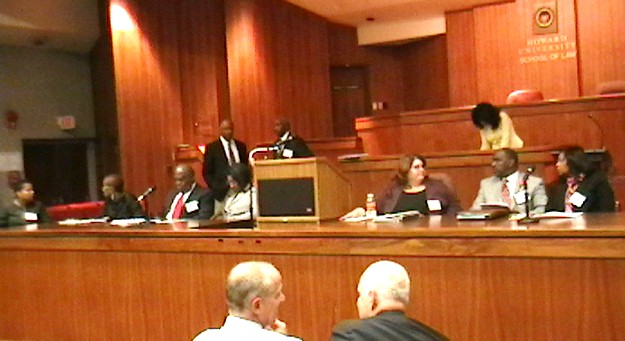
Opening Session at Howard Law School a Big Success


Kurt L. Schmoke, John Rosenthall
The grand opening session of the Fourth Annual State of Environmental Justice In America 2010 Conference at the Howard University School of Law was a huge success. A great crowd braved rain showers to listen to presentations and ask questions in the Moot Court Room.

Howard University School of Law Dean Kurt L. Schmoke welcomed everyone and the Honorable Marilyn Murrell, Mayor of Arcadia, Oklahoma and Chairperson of the National Small Town Alliance, gave an inspirational greeting. Lessie Price, Manager, URS Washington Division, was the moderator for the panel, which addressed the theme: "Green Jobs, Clean Energy & Succession Planning."

EJ Conference, Inc conference coordinator John Rosenthall gave the purpose of the conference and welcome the participants.

Panelists included Nikki Buffa, Associate Director for Communities, Environmental Protection & Green Jobs, White House Council on Environmental Quality

Cynthia Anderson, Director, American Recovery and Reinvestment Act Funding, Office of Environmental Management, United States Department of Energy

June Robinson, Senior Program Analyst, Chief Human Capital Office, United States Department of Energy

Reginal Barner Jr., President & CEO, The Barner Group

Dr. Lilia Abron, President & CEO, PEER Consultants PC

Dr. Beverly Hogan, President, Tougaloo College

Brendolyn Jenkins, Executive Director, The Imani Group, Inc.

Jacqueline Ponti-Lazaruk, Assistant Administrator, Water and Environmental Program, U.S. Department of Agriculture

Dr. Benjamin Chavis, Jr., President, Education Online Services Corporation

Robert Stanton, Senior Advisor, United States Department of the Interior

Okianer Dark, Associate Dean, Howard University School of Law gave closing remarks and an excellent reception followed in the Dining Hall

Registration

Friday, May 7, 2010

Damu Smith: 4 Years Since His Death


Damu Smith died on May 5, 2006. He was a dynamic environmental advocate. Everybody in the environmental community has some memory of this dynamic brother. Damu was universal. Damu gave Greenpeace 'cred.' Damu inspired the environmental justice community. Damu inspired the peace community. Damu inspired the religious community. In short, Damu was an inspiration. Easy going and rarely confrontation in personal interactions, he was dynamically confrontation for the causes he believed in.

Damu's illness was first revealed by The Washington Post, which reported on his collapse while working for peace in Israel. Although that newspaper never covered Damu in his life, they did cover his death. Their loss.

Damu Smith loved to speak and was a great speaker. He loved helping low-income and other disadvantaged people. Damu fought for years to protect people in Cancer Alley in Louisiana from additional pollution. He founded and ran Black Voices for Peace and the National Black Environmental Justice Network.

We will never forget you Damu. You were the coolest cat in the environmental justice movement.