Thursday, May 27, 2010

NEJAC Public Teleconference Meeting June 15, 2010

Registration Now Open‏

The National Environmental Justice Advisory Council (NEJAC) will host a Public Teleconference Meeting June 15, 2010 from 1:00 to 4:00 pm (Eastern) to discuss EPA’s response to the BP Oil Spill in the Gulf of Mexico.

In light of the recent oil spill in the Gulf Coast, and NEJAC’s continued interest in the effects of such disasters on surrounding communities, NEJAC will host a public teleconference call on Tuesday, June 15, 2010. The primary purpose of the call is to discuss EPA’s activities related to the Gulf of Mexico oil spill, including cleanup and recovery actions, and the impacts of the spill on coastal environmental justice communities. There will be a public comment period from 2:30 p.m. to 4:00 p.m. Eastern Time. Members of the public are invited to provide comments relevant to the topic of this teleconference meeting. Specifically, the NEJAC is seeking input about:

(1) The scope of disaster preparedness efforts within communities.
(2) How should EPA engage other federal, state, tribal, and local governments to ensure that coastal planning and protection efforts are a high priority.
(3) How should EPA engage communities around the environmental cleanup and recovery actions.

A finite number of telephone lines will be reserved for the call. Registration is required. Full capacity is anticipated, so you are highly encouraged to register early.

Meeting Registration: Registration is required for everyone (including EPA and other federal employees). The registration deadline is Noon (12:00 p.m.) Eastern Time on Friday, June 11, 2010.

There are two easy ways to register:

By E-mail: Send an e-mail with “Register for the June NEJAC Teleconference” in the subject line. Please provide your name, organization, e-mail and telephone number for future follow-up as necessary.

By Phone or Fax: Send a fax (please print), or leave a message, with your name, organization, address, e-mail and telephone number to 877-773-1489.

Public Comment Period

In addition to presentations and discussions by community representatives, EPA senior management, and NEJAC members, there will be a public comment period.
Approximately 1.5 hours of the 3-hour call will be devoted to the public comment period.
You must pre-register to provide comments.

All comments will be limited to five minutes to ensure that as many participants as possible wishing to provide a comment may do so. Only one representative of a community, organization or group will be allowed to speak.

Written comments can also be submitted for the record.

The suggested format for individuals providing public comments is as follows: Name of Speaker, Name of Organization/Community, Address/Telephone/E-mail, Description of Concern, and Recommendations or desired outcome.

Written comments received by Noon (12:00 p.m.) Eastern Time on Friday, June 11, 2010, will be included in the materials distributed to the members of the NEJAC. Written comments received after that time will be provided to the NEJAC as logistics allow. All written comments should be sent to NEJAC.

For more information, please contact EPA Support Contractor, APEX Direct Inc., at 877-773-1489.

Tuesday, May 18, 2010

EPA Environmental Justice Awards Program Application


EPA is looking for 2010 applications!

EPA’s National Achievements in Environmental Justice Awards Program recognizes community-initiated, multistakeholder partnerships that result in Environmental Justice Achievements in communities.

The goal of the Awards Program is to encourage achievement of public and environmental health results in communities, to foster collaborative problem-solving by all stakeholder organizations to address significant Environmental Justice concerns, and to document successful activities that can be used in other communities.

Applications must be postmarked by August 13, 2010.

More information

Friday, May 14, 2010

Exhibits: Environmental Justice in America 2010


Exhibitors:

• U.S. Department of Energy
• U.S. Environmental Protection Agency
• U.S. Department of Interior
• U.S. Department of Agriculture
Office of Forest Service
Office of Rural Development
• Heat Smart Campaign
• RPM Ecosystems

Day 3: Plenary Sessions & Congressional Luncheon


Plenary - USDA Equitable Environmentalism
Edmund Gee, U.S. Forest Service
Beattra Solomon Wilson, U.S. Forest Service
Session Manager: Pat Jackman, U.S. Forest Service

Plenary- Environmental Justice at DOE Sites
Stephanie Owens, U.S. Environmental Protection Agency
Gerald Boyd, Manager, Oak Ridge Site Office
Vincent Adams, Manager, Portsmouth Site Office

Plenary - Environmental Health Issues in Indian Country
Derrick Watchman, Watchman & Associates
Jerry Pardilla, National Tribal Environmental Council
Stacy A. Bohlen, National Indian Health Board
Perry H. Charley, Dine’ College
Session Manager: Karyn Collins, U.S. Department of Energy

Congressional Closing Luncheon A Discussion on Health, Energy and Jobs
Dr. David Rivers, Medical University of South Carolina
Presiding: The Honorable Donna M. Christensen, U.S. House of Representatives, D-Virgin Islands
Panel:
The Honorable Donald Payne,
U.S. House of Representatives, D- New Jersey, 10th District
The Honorable Judy Chu (invited),
U.S. House of Representatives, D- California, 32nd District
The Honorable G.K. Butterfield (invited),
U.S. House of Representatives, D- North Carolina, 1st District
The Honorable Emanuel Cleaver (invited),
U.S. House of Representatives, D- Missouri, 5th District
The Honorable Charles Gonzalez (invited),
U.S. House of Representatives, D- Texas, 20th District
Closing Remarks

Day 2: Concurrent Sessions: EJ in America 2010


Washington Marriot Hotel at Metro Center
Washington, DC

The Price of Environmental Racism in a Community:
The History and Potential Future of Hyde Park, Augusta, GA

Curtis Fease, Augusta State University
Julie Hudson, Augusta State University
Ashlyn Meyers, Augusta State University
Heather Valentine-Gates, The Urban Environment Institute of Georgia
Plastic Bottles and Environmental Justice:
Michael Biggs, Tennessee State University

EDUCATE, EMPOWER, EMPLOY
SRS Superfund Job Training Initiative
Brendolyn Jenkins, The Imani Group, Inc.
Session Manger: Denise Mercer, SM Stoller Corporation

Working for Food Justice: Geospatial technology Applications in Delineating Urban Food Deserts and Associated Racial Health Disparities
Nekya Young, Tennessee State University
Ethnicity, Income and Exposure to Heavy Metals by Urban Gardeners
Jennifer Gorospe, San José State University
Urban Inner City- Treks-n-Trails
Kwame Lillard, African American Cultural Alliance
Session Manager: Pamela Pontillo, U.S. Department of Energy

Transforming and Diversifying HBCUs through Collaborative Relationships
Senora Coggs, U.S. Department of Commerce
Ty Couey, Mid-Atlantic HBCU Alumni Association Collaboration
Karen Wilson, Tougaloo College
Sandra Lawson, Univ of District of Columbia
Session Managers: Sheryl Good, U.S. Environmental Protection
Nick Ogden, Jr., U.S. Department of Commerce

Brownfields and Environmental Justice: New Initiatives for a New
Decade of Community Revitalization

Joe Bruss, U.S. Environmental Protection Agency
Deeohn Ferris, Sustainable Communities Development Group, Inc.
Aimee Storm, U.S. Environmental Protection Agency
Session Manager: Shirley Wade, SM Stoller Corporation

Hawaii: A Case for Re-Characterizing the "Environment" in Environmental Justice
Laura Baker, U.S. Environmental Protection Agency
Workshop: Evaluating Environmental Justice Strategies in Federal Agencies: A Regional Focus
Ryan Jackson, Columbia University

Norris McDonald, Ben Wilson, Robert Stanton, John Rosenthall

The Time is Now: Implementation of Environmental Justice Policy in the Obama Administration
Daria Neal, Lawyers Committee for Civil Rights

Dialogic Transformations in US Land Revitalization Policy and Planning
Courtney Knapp, Northern Middlesex Council of Governments
Session Manger: Rhonda Brown, U.S. Department of Agriculture

Putting the Neighbor Back in the ‘Hood
LaTrenia Byrd, University of Arkansas
Ratnasari Dewi, University of Arkansas
Nathaniel Owen, University of Arkansas

Chemicals in Your Community: What You Need to Know
Deborah Brown, U.S. Environmental Protection Agency
Session Manager: Fred Jenkins, U.S. Environmental Protection Agency

Ignacia Moreno, Eric Holder

Lunch Keynote
Ignacia Moreno, Assistant Attorney General, Environment and Natural Resources Division, U.S. Department of Justice

Introduction and Presiding Officer: Cheryl Cook, Deputy Under Secretary, U.S. Department of Agriculture

Agnes L. Savoy
DOE Environmental Research
Rukia Dahir, George Washington University
Jennifer Lynette, George Washington University
Elizabeth Krone, George Washington University
Macrina Xavier, George Washington University
Jason Fraley, George Washington University


Lilia Abron, James Hill

Elemental Composition of Influent, Treated Sludge and Effluent Water
Randy Arnold, Savannah State University
Session Manager: Holly Cairns, Department of Environmental Protection, State of Pennsylvania

Plenary - Historically Black Colleges and University/Minority Serving Institutions
Calvina Allen Dupre, U.S. Agency for International Development
Senora Coggs, U.S. Department of Commerce

David Padgett, Kimberly Jackson
Workshop: Geographic Information Systems Applicants in Environmental Justice David Padgett, Tennessee State University
Christopher Norwood, Tennessee State University
Honoring Navajo Code Talker Brother Jack Jones Practical Retrofit of Sustainable Building Technologies to Native American Church Facilities and Entry Level Housing for Citizens and Discussion on Micro-Growing Programs.
Michael Loya, La Mesilla Verde
Session Manager: Beverly Whitehead, U.S. Department of Energy

Patricia Jackman, John Rosenthall

African American Stakeholder’s Environmental Perception with Regard to a Major Urban Development Project
Hermaine Pierre, Tennessee State University
Organizing Across Boarders: Building a Global for Environmental and Climate Justice
Nina Birger, Tufts University
Emily Pistell, Tufts University
RPM Urban Agroforestry
Leslie Carrere, RPM Ecosystems
Session Manager: Heather Valentine – Gates, The Urban Environment Institute of Georgia

John Rosenthall, Mayor Joe Phillips
Can Environmental Justice Go Worldwide? Inclusive Decision Making for People Living in Poverty in Developing Countries
Joseph Foti, World Resources Institute
A Seat at the Table - Book Discussion
Alisa Zomer, World Resources Institute

The Heat Smart Campaign- The Gift of Warmth
Donna Montaquila, Heat Smart Campaign
Lindsey Brickle, Vision
Session Manager: Marsha Middleton, M-Squared Public Relations

Special Presentation: Film - The Return of Navajo Boy
Jeff Spitz, Groundswell Films

The Defense Department, Climate Change and Environmental Justice (Video)
Norris McDonald, Center for Environment
John McCormick, Energy Policy Center


Purpose of the EJ 2010 Conference

John Rosenthall
Purpose:

John Rosenthall
EJ Conference, Inc.

Environmental justice requires fair treatment and meaningful involvement for all in environmental decisions and actions. Fair treatment and meaningful involvement are four words with plain and clear meanings when taken at face value. However, when combined into terms and applied to issues related to environmental actions, they assume different meanings in different quarters for different people.

This session will feature a moderated environmental justice conversation that will discuss the application of fair treatment and meaningful involvement from different interests and perspectives. It addresses questions such as: How can environmental justice and economic development co-exist? How can we improve relations between communities and industry, communities and government, and government and industry? What are examples of model environmental justice activities? What have been the major accomplishments of Executive Order 12898 on Environmental Justice? Has the Executive Order improved matters in environmental justice communities? Are the Federal agencies committed to implementing the Executive Order? Is business and industry committed to environmental justice? What are the most significant environmental justice issues facing the country?

Second Day of 2010 EJ Conference: Welcome Message


Melinda Downing
Message from the Department of Energy’s
Environmental Justice Program Manager

Welcome to "The State of Environmental Justice in America 2010 Conference". This is the fourth conference in this series that began in 2007. The Department of Energy (DOE) is pleased to be a sponsor of this conference series.

Environmental justice is actually a principal of American democracy that combines civil rights with environmental protection. It demands that those who have historically been excluded from environmental decision-making, traditionally minority, low-income and tribal communities, have the same access to environmental decision-makers, decision-making processes and the ability to make reasonable contributions to policy formulations as any other individual.

Environmental justice works best when communities are able to care for themselves and can determine their own environmental fate. A community that is environmentally aware and is an active participant in environmental decision-making is the best source for environmental protection. In those instances where a community lacks environmental knowledge or access to adequate technical assistance, the government may provide assistance to the community to acquire the knowledge and technical assistance to provide for its own environmental protection. In order to provide assistance to communities, DOE has developed and conducts a number of programs to help gain and sustain the necessary tools to achieve environmental justice for themselves.

It was at the State of Environmental Justice (EJ) in America Conference that DOE released our revised EJ Strategy, and announced our Five-Year Implementation Plan. The Plan is a series of activities that we will conduct in order to meet the goals set forth in the Strategy. At the end of 2009, we released the results of the first year of the Plan. The results show that we are well on the way to meeting all of the goals and demands of the Strategy. Environmental justice is a key component of our mission that we take seriously through the Department, and that fact is reflected in the implementation activities completed during the first year of the Plan.

As the Environmental Justice Program Manager for the Department of Energy, I am excited to have a number of my colleagues participating in the conference. I appreciate their presence and support. In addition to the Headquarters representatives, we have the Managers from our Oak Ridge Operations Office, Oak Ridge Tennessee and Portsmouth, Ohio presenting. They are committed to environmental justice, and I look forward to their presentations.

I hope you enjoy the conference and leave more enlightened about environmental justice than you were prior to attending the conference.

Melinda Downing
Environmental Justice Program Manager

Wednesday, May 12, 2010

Opening Session at Howard Law School a Big Success


Kurt L. Schmoke, John Rosenthall
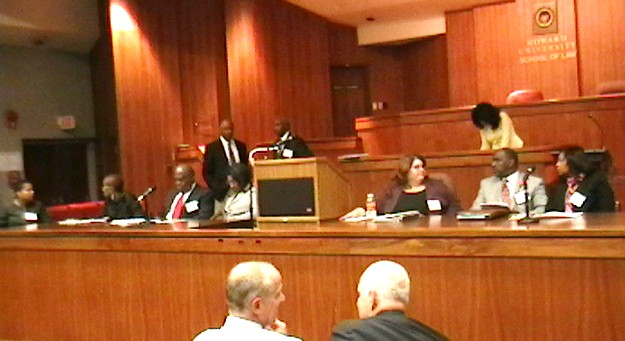
The grand opening session of the Fourth Annual State of Environmental Justice In America 2010 Conference at the Howard University School of Law was a huge success. A great crowd braved rain showers to listen to presentations and ask questions in the Moot Court Room.

Howard University School of Law Dean Kurt L. Schmoke welcomed everyone and the Honorable Marilyn Murrell, Mayor of Arcadia, Oklahoma and Chairperson of the National Small Town Alliance, gave an inspirational greeting. Lessie Price, Manager, URS Washington Division, was the moderator for the panel, which addressed the theme: "Green Jobs, Clean Energy & Succession Planning."

EJ Conference, Inc conference coordinator John Rosenthall gave the purpose of the conference and welcome the participants.

Panelists included Nikki Buffa, Associate Director for Communities, Environmental Protection & Green Jobs, White House Council on Environmental Quality

Cynthia Anderson, Director, American Recovery and Reinvestment Act Funding, Office of Environmental Management, United States Department of Energy

June Robinson, Senior Program Analyst, Chief Human Capital Office, United States Department of Energy

Reginal Barner Jr., President & CEO, The Barner Group

Dr. Lilia Abron, President & CEO, PEER Consultants PC

Dr. Beverly Hogan, President, Tougaloo College

Brendolyn Jenkins, Executive Director, The Imani Group, Inc.

Jacqueline Ponti-Lazaruk, Assistant Administrator, Water and Environmental Program, U.S. Department of Agriculture

Dr. Benjamin Chavis, Jr., President, Education Online Services Corporation

Robert Stanton, Senior Advisor, United States Department of the Interior

Okianer Dark, Associate Dean, Howard University School of Law gave closing remarks and an excellent reception followed in the Dining Hall

Registration

Friday, May 7, 2010

Damu Smith: 4 Years Since His Death


Damu Smith died on May 5, 2006. He was a dynamic environmental advocate. Everybody in the environmental community has some memory of this dynamic brother. Damu was universal. Damu gave Greenpeace 'cred.' Damu inspired the environmental justice community. Damu inspired the peace community. Damu inspired the religious community. In short, Damu was an inspiration. Easy going and rarely confrontation in personal interactions, he was dynamically confrontation for the causes he believed in.

Damu's illness was first revealed by The Washington Post, which reported on his collapse while working for peace in Israel. Although that newspaper never covered Damu in his life, they did cover his death. Their loss.

Damu Smith loved to speak and was a great speaker. He loved helping low-income and other disadvantaged people. Damu fought for years to protect people in Cancer Alley in Louisiana from additional pollution. He founded and ran Black Voices for Peace and the National Black Environmental Justice Network.

We will never forget you Damu. You were the coolest cat in the environmental justice movement.

Monday, April 19, 2010

CBC & EPA South Carolina Joint Environmental Justice Tour


EPA, Congressional Black Caucus Visit South Carolina on Joint Environmental Justice Tour

Marks second stop in nationwide tour highlighting impact of environmental issues on underserved communities

On Sunday, April 18 and Monday, April 19, as part of the joint nationwide Environmental Justice Tour between the U.S. Environmental Protection Agency (EPA) and members of the Congressional Black Caucus (CBC), EPA Administrator Lisa P. Jackson traveled to South Carolina to highlight challenges faced by underserved communities in the area. South Carolina marked the second stop in the nationwide tour and included meetings and public events with U.S. Rep. James E. Clyburn (D-SC) and Delegate Donna M. Christensen (D-VI) in the cities of Spartanburg, Columbia, Aiken and North Charleston.

On Sunday in Columbia, EPA and the CBC hosted an Environmental Justice Town Hall at Allen University with the participation of hundreds of community leaders, elected officials, students and religious leaders. At the town hall, Administrator Jackson announced $1.4 million in brownfields funds for South Carolina, as part of a larger national announcement of nearly $80 million to 40 states, to clean up and redevelop hazardous waste sites. These investments and jobs target local, underserved and economically disadvantaged neighborhoods – places where environmental cleanups and new jobs are most needed.

Earlier in the day, the delegation toured the ReGenesis Project in Spartanburg, a former brownfields site that a community-based organization has leveraged millions in funding for redevelopment. The project, a model for environmental justice organizations across the state, received an EPA Environmental Justice Achievement Award for its work to protect the health and environment of this community while promoting economic development.

Today, the delegation traveled to the Savannah River Site, a Superfund hazardous waste site receiving funds from the recovery act and visited an elementary school in North Charleston, which EPA is monitoring for toxic air pollution. Upcoming tour stops will include New York, Georgia, Michigan and Missouri, among other states.

Thursday, April 15, 2010

Environmental Justice Blog Named Among Top 50 Public Health Blogs


From Health Sherpa:

Top 50 Public Health Blogs

"After the Haitian eqrthquake news coverage, you might have realized the issues in that situation that pertained to public health. Business, food and drugs, a natural disaster, weather and the environmental all affected the Haitian population’s health after that earthquake. We tackled those topics as categories as we built this top 50 public health blog list for you to stay on top of public health issues from a local to global basis."


NEJAC Teleconference Meeting April 28 - Register Now


National Environmental Justice Advisory Council

National Public Teleconference Meeting

Wednesday April 28, 2010

Registration Now Open

The National Environmental Justice Advisory Council (NEJAC) will host a public teleconference call on Wednesday, April 28, 2010, from 2p.m. to 4 p.m. Eastern Time. The primary topics of discussion will be updates on EPA’s response to the NEJAC’s Goods Movement Report; and reports from the NEJAC liaisons to the Tribal Operations Commission and the Children's Health Protection Advisory Committee School Siting Task Group.

The draft agenda is as follows:

2:00 p.m. Welcome, Introduction and Role Call

2:10 p.m. Updates on EPA’s Response to the NEJAC’s Goods Movement Report and Reports from the NEJAC Liaisons to the Tribal Operations Commission and the Children's Health Protection Advisory Committee School Siting Task Group.

3:30 p.m. Public Comment Period

4:00 p.m. Adjourn

There will be a public comment period from 3:30 p.m. to 4:00 p.m. Eastern Time. Members of the public who wish to participate on the call or to provide public comment must pre-register by 11 a.m. Eastern Time Tuesday, April 27, 2010. Individuals or groups making remarks during the public comment period will be limited to a total time of five minutes. Only one representative of a community, organization or group will be allowed to speak. Written comments can also be submitted for the record. The suggested format for individuals providing public comments is as follows: Name of Speaker, Name of Organization/Community, Address/Telephone/E-mail, Description of Concern and its Relationship to a Specific Policy Issue(s), and Recommendations or desired outcome.

Written comments received by 5 p.m. Eastern Time Monday, April 26, 2010, will be included in the materials distributed to the members of the NEJAC. Written comments received after that time will be provided to the NEJAC as logistics allow. All written comments should be sent to EPA’s support contractor, APEX Direct, Inc via e-mail at or fax at (877) 773-0779.
You must pre-register to participate on the call. To register online


Thursday, April 1, 2010

New Report: Environmental Justice and the Green Economy


A Working Group representing eight organizations in six states have published two documents:

1- "Environmental Justice and the Green Economy: A Vision Statement and Case Studies for Just and Sustainable Solutions" and

2- "Stimulating Environmental Justice: How the States Can Use Federal Recovery Funds to Build a Just and Sustainable Economy."
Members of the working group include:

Bill Gallegos, Communities for a Better Environment (Los Angeles)
Denise Perry, Power U (Miami)
Kalila Barnett and Penn Loh, Alternatives for Community & Environment, Boston
Diane Takvorian, Environmental Health Coalition (San Diego)
Peggy Shepard and Cecil Corbin-Mark, West Harlem Environmental Action
Burt Lauderdale, Kentuckians for the Commonwealth
Donele Wilkins, Detroiters Working for Environmental Justice
Roger Kim, Asian Pacific Environmental Network (Oakland)

Monday, March 29, 2010

CDC & ATSDR Nat'l Conversation on Health & Chemicals


The National Conversation on Public Health and Chemical Exposures is supported by the Centers for Disease Control and Prevention (CDC) and the Agency for Toxic Substances and Disease Registry (ATSDR). It is a unique and unprecedented collaboration of federal, state, and local, and tribal government agencies; environmental and public health scientists, researchers, and leaders; community, faith-based, and nonprofit organizations; concerned citizens nationwide; and, representatives from private industry. Everyone who cares about the issues of chemical safety and public health is encouraged to lend his or her voice.

The goal of this National Conversation is to develop an effective, efficient, fair, and collaborative action agenda with recommendations for strengthening our nation’s efforts to protect the public from harmful chemical exposures.

The National Conversation is hosting the first of three facilitated Web dialogues to begin gathering public input from Monday, April 5 through Wednesday, April 7. Two virtual conversations will be conducted each day, and the public is invited to participate in one or all six. And because the National Conversation is committed to transparency, archives of all conversations will be available online for public review for five years. The agenda for the first Web dialogue includes:

· Monday, April 5: “Understanding the National Conversation” and “Achieving the National Conversation’s Vision”

· Tuesday, April 6: “Involving People in Decisions that Affect their Health” and “Improving Research & Information Collection & Management”

· Wednesday, April 7: “Preventing Harmful Exposures” and “Responding Effectively to Exposures.”
CDC and ATSDR invite you to participate personally in and blog about this first Web dialogue, and encourage you to invite others to do the same.

For more information and to register for this event

This dialogue is just the first of several upcoming opportunities for the public to participate in the National Conversation. In the coming months, CDC & ATSDR will also be launching:

· The Community Conversation Toolkit, a downloadable resource to encourage real-world conversations. This toolkit will provide background information on chemical exposure issues, a discussion guide, and directions for providing input to the larger National Conversation.

· Two more facilitated Web dialogues to garner public input on developing National Conversation efforts as well as the draft action agenda.
Additional requests for information can be directed to Dagny Olivares at CDC

You can also help keep the conversation going by following us on Twitter and Facebook.

Friday, March 26, 2010

EPA 2010 National Asthma Forum


Register today for the 2010 National Asthma Forum June 17-18, 2010, in Washington, D.C.


Join hundreds of dedicated health care professionals, community organizations, and other leaders to learn what it takes to create strong and sustainable asthma programs in your community.

Network with leaders in asthma care and hear best practices for community-based programs.
Learn how to evaluate your program’s impact, attract funders for program sustainability, and improve health outcomes through home-based environmental interventions.

Create your community’s leadership plan for asthma action with national asthma leaders.
Share your program’s successes with a national audience. Registration is now open.


EPA


Monday, March 22, 2010

Why Is John Rosenthall Smiling?


He'll probably wait until the conference to tell us.

The conference coordinator is happy.

The schedule must be going really well.

It must be the speakers list.

Or the attendees. Or a special presenter.

He clearly knows something that he wants to share.

Friday, March 19, 2010

Nat'l Conversation on Public Health and Chemical Exposures


Online dialogues will take place April 5-7, 2010.

For questions regarding the National Conversation, please e-mail

Click on image to enlarge

Environmental Justice: Volume 3, Number 1


Mary Ann Liebert, Inc publishers have issued "Environmental Justice: Volume 3, Number 1" and it includes interviews, original articles, a White House meeting report from last year, and a book review. Founded in 1980, Mary Ann Liebert, Inc. is acknowledged for publishing peer-reviewed journals, books, and trade magazines in the areas of biotechnology, biomedical research/life sciences, clinical medicine and surgery, alternative and complementary medicine, law, philanthropy, environmental science and sustainability.

Thursday, March 18, 2010

EPA Good Jobs, Green Jobs National Conference


The 2010 Good Jobs, Green Jobs National Conference will take place May 4-6, 2010 in Washington, DC and will bring together union members, environmentalists, business leaders, elected and administration officials. The three day conference will include keynotes, plenaries and workshops dedicated to building a green economy that creates good jobs, reduces global warming and preserves America’s economic and environmental security.

This year’s Conference will also feature the 2010 Green Jobs Expo, which will showcase the companies, products, services and career opportunities in the green economy. Participating in the Expo provides companies and organizations exposure to attendees of the Good Jobs, Green Jobs National Conference, who come from all facets of industry, academia, government and the non-profit sector, as well as students from colleges, universities and trade schools in the area.

Register

Conference Contact: Carlton Eley


Monday, March 15, 2010

Earth Day 2010


This is the 40th Anniversary of the Original Earth Day in 1970. The Earth Day Network is coordinating activities to commemorate the anniversary. They are encouraging individual, organizations, agencies, businesses, and others to plan events to celebrate this day for the Earth.

Global Days of Service – April 17-18, 2010 - will feature Volunteer Actions by tens of thousands of global participants. These projects in parks, beaches, schools and forests will focus on climate change solutions like tree planting, energy efficiency retrofits, water protection, urban gardens and forest restoration. Volunteer activities will be quantified though their events registration tool and carried out through local partners around the world. Click here to sign up as a partner!

Events on The National Mall in Washington, DC

Earth Day 40th Anniversary Events – April 22

Change the Climate Rally – April 25

Exhibitions and Performances on The National Mall – April 17-25

Earth Day Action Center: A Project of Earth Day Network